
For Pakistani students dreaming of a medical career, the question is no longer just “which medical school?” — it is increasingly “which country?”
Over 10,000 Pakistani students are currently enrolled in MBBS programs at Chinese universities. That number has grown steadily every year, driven by a combination of lower costs, easier admission, and internationally recognised degrees.
But is MBBS in China actually the right choice for every student? And how does it compare to staying in Pakistan?
This guide gives you an honest, detailed comparison across every factor that matters — costs, admission requirements, degree recognition, quality of education, and career prospects — so you can make the right decision for your future.
Quick Comparison: MBBS in China vs Pakistan
| Factor | MBBS in China | MBBS in Pakistan |
|---|---|---|
| Annual Tuition | $3,000 – $6,000 | PKR 800,000 – 3,500,000 |
| Total Program Cost | $20,000 – $35,000 | PKR 5M – 20M+ |
| Program Duration | 6 years (inc. internship) | 5 years + 1 year house job |
| IELTS Required | No (for most universities) | No |
| Entry Test | No (MDCAT not required) | MDCAT required |
| Medium of Instruction | English | English |
| WHO Recognition | Yes (listed universities) | Yes |
| PMC/HEC Recognition | Yes (listed universities) | Yes |
| Scholarships Available | CSC, CPEC, University grants | Limited |
| Admission Difficulty | Moderate | Very high (limited seats) |
The Core Problem With MBBS in Pakistan
Let us be direct: getting into a government medical college in Pakistan is extremely difficult.
There are approximately 1,200 government MBBS seats available across all provinces for tens of thousands of applicants every year. The competition is intense, the MDCAT cutoff scores are climbing, and even students with strong grades regularly miss out.
Private medical colleges in Pakistan do offer more seats — but at a significant cost. Annual tuition at a private medical college can range from PKR 800,000 to over PKR 3,500,000, making a full MBBS degree an investment of PKR 5 million to 20 million or more — before living expenses.
For many talented Pakistani students, this combination of limited seats and high private costs has made MBBS in Pakistan either inaccessible or unaffordable. China has emerged as the most credible alternative.
Cost Comparison: MBBS in China vs Pakistan
MBBS in China — Cost Breakdown
| Expense | Annual Cost (USD) |
|---|---|
| Tuition | $3,000 – $6,000 |
| University Accommodation | $500 – $1,200 |
| Food & Living | $2,000 – $4,000 |
| Health Insurance | $100 – $200 |
| Total per Year | $5,600 – $11,400 |
| Full 6-Year Program | $33,600 – $68,400 |
In Pakistani rupees at current exchange rates, a full MBBS in China costs approximately PKR 9M – PKR 19M — and that is without any scholarship. With a CSC or CPEC scholarship, tuition, accommodation, and a living stipend can all be fully covered, bringing your personal cost close to zero.
MBBS in Pakistan — Cost Breakdown
| Expense | Annual Cost (PKR) |
|---|---|
| Government College Tuition | PKR 50,000 – 200,000 |
| Private College Tuition | PKR 800,000 – 3,500,000 |
| Living Expenses (hostel/rent) | PKR 300,000 – 600,000 |
| Government: Total per Year | PKR 350,000 – 800,000 |
| Private: Total per Year | PKR 1,100,000 – 4,100,000 |
Government medical colleges in Pakistan are by far the most affordable option — but as discussed, seats are extremely limited and competition is fierce. Private colleges are accessible but expensive.
Verdict: If you get a government medical college seat in Pakistan, that is likely your most affordable option. If you are looking at private colleges in Pakistan, MBBS in China is almost always significantly cheaper — and often comes with scholarship options that make it even more cost-effective.
Admission Requirements: Which Is Easier to Get Into?
MBBS in China
-
- FSc Pre-Medical (or equivalent) with at least 60% marks
-
- No MDCAT required
-
- No IELTS required (English medium certificate accepted)
-
- Statement of Purpose
-
- Passport and basic documentation
-
- No entrance exam in most cases
The admission process for Chinese universities is primarily document-based. Strong grades help, but there is no high-stakes single-day entrance exam determining your fate.
MBBS in Pakistan
-
- FSc Pre-Medical with strong marks (typically 80%+ for competitive programs)
-
- MDCAT score — minimum 55% required, but competitive programs demand much higher
-
- Provincial domicile requirements apply for government colleges
-
- Private colleges have lower cutoffs but charge significantly more
Verdict: MBBS in China has considerably more accessible admission requirements. This is not about lower standards — it is about a different admissions philosophy. Chinese universities assess students holistically across their academic history rather than through a single entrance exam.
Quality of Education
This is the question Pakistani parents ask most — and it deserves a direct, honest answer.
Medical Education in China
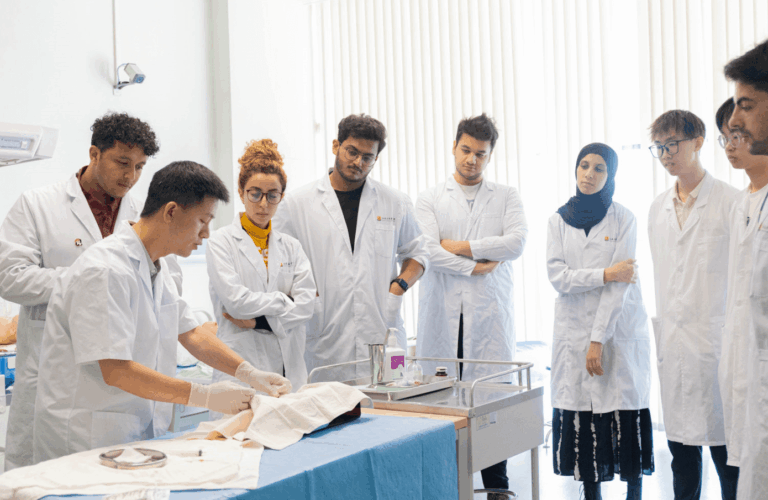
China has invested heavily in its medical universities over the past two decades. The top medical universities — Wuhan University, HUST, Central South University, Jilin University — are equipped with modern simulation labs, teaching hospitals, and research facilities that match or exceed many private medical colleges in Pakistan.
MBBS programs in China are typically 6 years, structured as:
-
- Years 1–2: Basic medical sciences (anatomy, physiology, biochemistry)
-
- Years 3–4: Clinical sciences and preclinical training
-
- Years 5–6: Clinical rotations in affiliated teaching hospitals
Pakistani students are taught in English throughout the program. Clinical exposure in China’s large teaching hospitals — which serve enormous patient populations — is extensive.
Medical Education in Pakistan
Pakistan’s top government medical colleges — King Edward Medical University, Aga Khan University Medical College, Dow Medical College — are genuinely world-class institutions with strong clinical training, experienced faculty, and deep networks within Pakistan’s healthcare system.
Private medical colleges in Pakistan vary considerably in quality. Some are excellent; others are accredited but offer limited clinical exposure and facilities. The reputation of the institution matters significantly when it comes to employment and residency applications in Pakistan.
Verdict: The top Chinese medical universities offer excellent quality education that is more than adequate for building a strong medical career. Pakistan’s elite government colleges are outstanding — but access to them is limited. For students comparing Chinese universities to mid-tier or lower-tier private colleges in Pakistan, China often wins on both quality and cost.
Degree Recognition: Will My MBBS from China Be Valid in Pakistan?
This is the most important question — and the answer is yes, with conditions.
PMC (Pakistan Medical Commission) Recognition
The Pakistan Medical Commission maintains a list of recognised foreign medical institutions. Pakistani students who graduate from a PMC-recognised Chinese university can:
-
- Return to Pakistan and sit the PMDC/PMC Screening Examination
-
- Upon passing, register as a medical doctor in Pakistan
-
- Apply for postgraduate training, house jobs, and specialisation
The PMC screening exam tests clinical knowledge and is a standard requirement for all foreign-trained doctors returning to Pakistan, regardless of which country they studied in.
WHO Recognition
The World Health Organisation maintains the World Directory of Medical Schools (WDOMS). MBBS degrees from WHO-listed Chinese universities are internationally recognised, opening doors to licensing examinations in other countries including the USMLE (USA), PLAB (UK), and AMC (Australia).
Which Chinese Universities Are PMC Recognised?
The PMC-recognised list changes periodically, so always verify before applying. Universities consistently on the recognised list include:
-
- Wuhan University
-
- Huazhong University of Science and Technology
-
- Central South University
-
- Jilin University
-
- Xi’an Jiaotong University
-
- China Medical University
-
- Harbin Medical University
Drop Your Case only helps students apply to PMC and WHO recognised universities. This is non-negotiable in our admissions process — we will not place a student at an unrecognised institution.
Check which universities DYC works with →
Verdict: MBBS from a recognised Chinese university is fully valid in Pakistan. You will need to pass the PMC screening exam, which is standard for all foreign-trained doctors. Plan for this as part of your overall timeline.
Career Prospects After MBBS
Graduating From a Chinese University
After completing your MBBS and returning to Pakistan:
-
- Pass the PMC screening exam to register as a doctor
-
- Apply for house job placements at government or private hospitals
-
- Career trajectory from this point is identical to domestic graduates
Pakistani students who graduated from Chinese medical universities are now practising doctors across Pakistan, and many have gone on to postgraduate specialisation. The degree is no longer unusual or stigmatised — it is increasingly mainstream.
International Options
If you are considering practising medicine outside Pakistan, an MBBS from a WHO-recognised Chinese university gives you a pathway to:
-
- USA: USMLE Steps 1, 2, and 3 (same as any foreign medical graduate)
-
- UK: PLAB examination with GMC registration
-
- Middle East: Most Gulf countries recognise WHO-listed degrees
-
- Canada, Australia: Additional licensing requirements but pathways exist
Verdict: Career prospects after MBBS in China are strong, provided you graduate from a PMC and WHO recognised university. The PMC screening exam is the one additional hurdle compared to domestic graduates — factor this into your planning.
Scholarships: A Major Advantage for China
One area where MBBS in China has a clear, unambiguous advantage is scholarship availability.
Pakistani students pursuing MBBS in China can apply for:
Chinese Government Scholarship (CSC) — Fully funded: tuition, accommodation, and a monthly stipend of 2,500 RMB. Available at most top medical universities.
CPEC Scholarship — Dedicated to Pakistani students under the China-Pakistan Economic Corridor. Fully funded with additional benefits.
University Scholarships — Most Chinese medical universities offer their own merit-based partial or full scholarships for international students.
There is no equivalent scholarship program of this scale for Pakistani students studying medicine domestically. If cost is a major factor in your decision, the scholarship landscape in China is a significant advantage.
Explore scholarship options for Pakistani students →
So: China or Pakistan?
Here is our honest recommendation:
Choose MBBS in Pakistan if:
-
- You score high enough in MDCAT to secure a government medical college seat
-
- You want to build your career and network primarily within Pakistan’s healthcare system
-
- Cost is not a major constraint and you prefer studying at home
Choose MBBS in China if:
-
- You did not secure a government college seat in Pakistan
-
- You are comparing against private medical college fees in Pakistan
-
- You want access to scholarships that can significantly reduce or eliminate costs
-
- You are open to an international experience and want a WHO-recognised degree
-
- IELTS or MDCAT scores are a barrier
The honest reality is this: for students who cannot access Pakistan’s government medical colleges, MBBS in China — particularly at a PMC and WHO recognised university with a CSC or CPEC scholarship — is one of the best value medical education pathways available to Pakistani students anywhere in the world.
How Drop Your Case Can Help
Choosing the right university, securing the right scholarship, and navigating the application process is where most students need help. DYC specialises exclusively in the Pakistan-to-China education pathway.
We will:
-
- Match you with PMC and WHO recognised medical universities based on your grades and budget
-
- Handle your full application and documentation
-
- Apply for CSC and CPEC scholarships on your behalf
-
- Guide you through the student visa process step by step
Frequently Asked Questions
Is MBBS from China valid in Pakistan? Yes — provided you graduate from a PMC-recognised Chinese university and pass the PMC screening examination upon return. DYC only works with recognised institutions.
Do I need to pass an exam after returning from China? Yes. All Pakistani doctors who trained abroad must pass the PMC screening exam before registering to practise in Pakistan. This is the same requirement for graduates from the UK, USA, or any other country.
How long does MBBS take in China? Six years in total — five years of academic study plus a one-year clinical internship, typically completed at the university’s affiliated teaching hospital in China.
Can I do postgraduate specialisation after MBBS in China? Yes. After passing the PMC screening exam and completing your house job in Pakistan, you can apply for FCPS and other postgraduate qualifications through the College of Physicians and Surgeons Pakistan (CPSP), exactly as domestic graduates do.
What is the medium of instruction for MBBS in China? All programs listed by Drop Your Case are taught in English. Some universities offer dual-language programs (English and Chinese) — DYC advises on this during your consultation.